About Me

So yeah, I'm Zach and I'm a bit of a film nerd that's willing to share his thoughts. My earlier entries, starting with the first and ending roughly around the late sixties, are pretty amateurish, though. Other than those, however, you should find my thoughts to be at least *somewhat* interesting...hopefully... =P

Sunday, August 15, 2010

Entry#190: Scott Pilgrim vs. the World

Trailer

Edgar Wright is one of the most creative and hilarious directors out there right now. His previous films, Shaun of The Dead and Hot Fuzz, combined completely opposite genres (romantic-comedy/zombie horror and "cop-flick"/comedy) while creating films that were fresh, witty, and downright fun. Wright's third film, Scott Pilgrim vs. the World, is no exception to the formula of his previous films and it may be his most ambitious work to date. It's still filled with Wright's brilliant sense of humor, but the mash-up consists of a larger number of genres and the cinematography is much more inventive and creative this time around.

Based on the comic-book series of the same name, the film follows the geeky Scott Pilgrim, bass guitarist of the garage band "Sex Bob-omb", as he begins to date a high-school student, Knives, despite his friends' and bandmates' protests. Not much later, though, Scott meets the mysterious Ramona Flowers and begins to gain interest in her after their initial meeting. As Scott begins dating Ramona, cheating on Knives in the process, he's soon introduced - in a violent way - to the "League of Evil Exes". The group was formed by Gideon Graves, Ramona's seventh previous boyfriend, and its sole purpose is to defeat anyone that's romantically interested in Ramona. The rest of the film follows Scott as he battles Ramona's evil exes in a visually stylish romp of action and wit.

First off, I loved the characters in this movie. From the leading role to the smallest cameo, every role in this cast is simply fantastic. The characters are all well-written and interesting, with each having his/her own backstory and sense of place in this absolutely fun, imaginative, and nostalgic film. Most movie-goers may, at first, believe that Michael Cera (who plays Scott Pilgrim) is simply playing the same character that he always does, but he's really not. Thanks to the immense amount of talent from both Edgar Wright and Bryan Lee O'Malley, the writing's so great that the film, in a way, deconstructs the "hipster" type of characters that Cera's known for playing. It is, however, an admiring deconstruction as Pilgrim is still portrayed as an endearing and heartfelt character. I could literally go on and on about this film's cast because they were just that wonderful. Wallace Wells, Scott Pilgrim's gay roommate, would be a perfect example of the brilliant supporting cast. His dialogue's clever, the delivery is spot-on perfect, and he's just as interesting and lovable as the film's major characters. Even Ramona's exes have an interesting sense of style and personality. Todd, for instance, is a vegan whose veganism gives him telepathic and superhuman powers and he's a bit of a hilarious moron to boot. As the film is going for a retro-comic book/video game/anime feel, the over-the-top villains are hilarious, creative, and each one fits the mood of the film. There are so many more characters I could talk about - such as Kim, Stacey, or even Ramona herself - but the film exists for a reason. Out of all the films I've seen this year, this one is probably the most character-orientated and for that I'm grateful.

The visuals look spectacular as well. Using new and creative styles, Wright has been able to do something that few films have ever done before - bring a comic book to life. There have been plenty of "superhero" movies, mind you, but very, very, very few have actually felt like a live-action comic book or graphic novel. The only film that's succeeded in creating this atmosphere, besides this one, would be Quentin Tarantino's Kill Bill. That's not even based on previously existing material. The action sequences, for instance, look animated and just superb. The image is crisp and fresh while the interesting Dragon Ball Z-like fights are delightfully over-the-top and incredibly entertaining. Even if you're not mentioning the action sequences, the film still looks great. The editing techniques are highly impressive and the combination with the aesthetically-pleasing cinematography creates a visual treat that compliments the film's lovable cast of characters.

The humor's just as top-notch as Wright's previous films as well. The dialogue's very witty and the humor is virtually non-stop thanks to the film's frantic pacing. Just as one joke's ended, another one's more than likely started. Also, there are plenty of quotable moments from Scott Pilgrim that prove to be just as effective and hilarious as Wright's other two films. I won't spoil any, but I can assure any readers that they're really funny. Even the few moments of physical humor prove to be pretty funny, which is saying something for me as I can't stand slapstick.

Part of what makes the film so enjoyable is the fact that it connects with its major audiences' nostalgia and music taste. If you've ever been into video games or comic books, for example, there'll be plenty of subtle references to pick up on - from the Legend of Zelda theme music to the Street Fighter-like start of matches. In many ways, this film is to Generation Y as films like Sixteen Candles and The Breakfast Club were to Generation X. The film knows exactly who its audience is and lets us know, through satire and admitted charm, about the pros and cons of this current generation. Even the music is catered to Generation Y's taste, as the film's soundtrack is filled with enough indie bands and tracks to make any "hipster" blush. From well-known indie musicians such as Beck and Metric to some lesser-known singers and bands, the film's music is just as enjoyable as the rest of the film. My personal favorite song, though, would have to be Metric's/Clash at the Demonhead's "Black Sheep". I could listen to that song for hours and never get tired of it.

If the film does have a harrowing flaw, however, it'd lie within the film's introduction. The characters don't seem as open or lovable in the first few minutes of the film, and it takes awhile before they open up enough for us to actually enjoy (or detest, as opinions vary) their company. Despite this smallish error within the first 15 - 20 minutes, I still loved this movie.

Scott Pilgrim vs. the World has to be one of the best movies to come out this year. It's original, filled with memorable and likable characters, and has a wicked and nostalgic sense of humor that's sure to please younger and older audiences.

Friday, August 13, 2010

Entry#189: Jack

Trailer

Is it possible for a film to be "bad" but still have a good message? If so, Jack would be the perfect example of such a film. Its humor is juvenile and forced, its characters are one-dimensional, and it only seems to exist for the sole purpose of pleasing mainstream audiences. However, at the end of the day (so to speak), it can't be denied that the film has a smart and emotional message. Does disliking the film mean that I disagree with the message or think that it's stupid? No, not at all. I do, however, think that this film - along with Bram Stoker's Dracula - proves that Francis Ford Coppola doesn't have a spotless career.

The film follows the titular Jack - a boy who grows four times faster than the rest of the world. By age ten, Jack appears to be a fully-grown 40-year-old man. Because of his condition and his parents' concern, Jack has spent his entire life being tutored at home. After his tutor recommends public schooling, though, Jack must try to fit in with his fellow fifth-graders despite his much older appearance.

The concept is decent, at best, but the film's characters are shallow and utterly annoying. There's no depth or sense of purpose in any of them, including our main character, Jack. They exist only to spout off terrible jokes and to advance the plot points of the film. Not only are the characters completely dull and lifeless, but they're very stereotypical as well. The "tough" kids are tough for the sake of the plot, the geeky kids exist to represent the "other" side of life in elementary school, etc. and so forth. The same can be said for literally all of the characters in this film - they're one-dimensional, boring, and painfully cliche.

Speaking of pain, the humor in this movie is utterly stupid. It relies on physical and schoolboy humor that gets insanely old before it's barely even introduced. There's nothing clever or witty about the script at all, as it's virtually nothing but slapstick and "fart jokes". There's even a sequence that tries for laughs with a "gross-out" food moment. It's not even remotely funny and I can't imagine how someone like Francis Ford Coppola (The Godfather, Apocalypse Now) could've directed something this awful. There is literally not one or even slightly humorous moment in the entire movie. It was just two hours of torture...

One other big flaw is that the film doesn't know who its audience is. Is it a movie aimed at children or adults? If it's adults, movie-goers may find themselves annoyed at the film's childish sense of humor. If it's for kids, the whole message and the sexual references will just fly over their heads while they laugh at jokes that call people "butt-breath". Not only that, but the budding flirtation between Jack and his friend's mother is just weird and completely out-of-place. I know that Jack LOOKS 40, but he's MEANT to be a ten-year-old. What ten-year-old tries to cop a feel, flirt with his friend's mom, or contemplate about the meaning of life? It's out-of-character and dreadfully forced.

Are there any good things about Jack? Slightly, yes. It's far from being a great performance, but Robin Williams is able to bring his usual charm to the bland role of Jack. The ending speech, by far, had to be his best moment in the film. The editing's decent enough, from what I recall, and the film knows how to manipulate a scene into an emotionally gut-wrenching moment. Finally, I did appreciate the film's overall message - stay young at heart and don't let the world take your soul. "Look to the stars", Jack says, and everything will be alright.

The film's got a great message, but Jack's pathetic characters and awful humor keep it in the category of a bad movie.

Wednesday, August 11, 2010

Entry#188: The Fall

Trailer

One of the biggest compliments to a filmmaker, besides an Oscar nomination, would be an endorsement by a recognized and acclaimed director. Plenty of directors have gotten their start this way and the tradition continues to this day. Recently, for example, Peter Jackson (Lord of The Rings, Heavenly Creatures) kick-started Neil Blomkamp's career by backing Neil's directorial debut, District 9. To have someone support your work like that is truly an honor and an easy jump-start for a film career. Because of how prestigious a director/sponser is, I was quite surprised to find out that The Fall had TWO well-known directors backing it up. Both David Fincher (Fight Club, Zodiac) and Spike Jonze (Being John Malkovich, Adaptation.), apparently, helped finance the film because they believed in it so much. That's saying something for an otherwise unknown filmmaker.

The Fall chronicles the relationship between a hospitalized young girl, Alexandria, and her new acquaintance and storyteller, Roy Walker. After a harsh fall, Roy finds himself bedridden, with his only company consisting of seemingly angry friends and an imaginative Romanian girl (aka Alexandria). As times passes and Alexandria visits more often, Roy discovers that he's slowly becoming addicted to the morphine that's been prescribed to him. With the addiction growing, Roy uses Alexandria to bring him more "sleeping pills" in exchange for a creative and lushious fairy tale. Reality and fantasy blur, though, as Roy's state of mind and Alexandria's imagination interweave with one another in the fairy tale.

The cinematography of the film is very well-done and artistic. Thanks to the use of color and conventional film methods, the director is able to create two distinct worlds with differing visual styles. The 'real' world, for example, relies on orange and gray coloring to portray the reality of 1920's America. Menawhile, the fantasy world is filled with every color imaginable to show off the power of imagination. Both worlds are visually-appealing and showcase the hard work that went into this film. The best sequence, though, has to be the film's opening credits. Those moments are so well-structured and so perfectly compositied that it feels like watching a living painting. Sharp, chiche, and creative, the visuals are a great component of the film.

The characters, though, are only decent to pretty good. We get to know Roy and Alexandria, but only on a limited basis. For instance, Alexandria is naive and charming, as virtually all little girls are, but we don't really get to know her character. If we compared the film with Pan's Labyrinth, a film with similar fairy-tale themes, we'd see that Alexandria feels flat while Ofelia, the main character of Pan's Labyrinth, is a more well-rounded and interesting character. The same can pretty much be said of Roy. However, I'm a bit iffy on the fairy tale characters. They're supposed to be simle, that's granted, but they can feel very generic in this film; almost like a cast from a below-average JRPG (Japanese Role-Playing Game) video game. All in all, the characters are interesting but only half-developed.

That said, the film still retains a fascinating narrative and a stylish and emotional atmosphere. The story flows quite smoothly and the interweaving of reality and fantasy proves to be just as interesting as it is emotionally-investing. Heck, I thought the characters were only "pretty good" but found myself in tears during the last twenty minutes of the film. The atmosphere really nailed that wodner that comes with fairy tales AND the harsh realities of life - and that isn't an easy task by any means.

I really liked The Fall. The characters were only decent but the atmosphere and lovely visuals definitely make up for it.

Tuesday, August 10, 2010

Entry#187: The Puffy Chair

Trailer

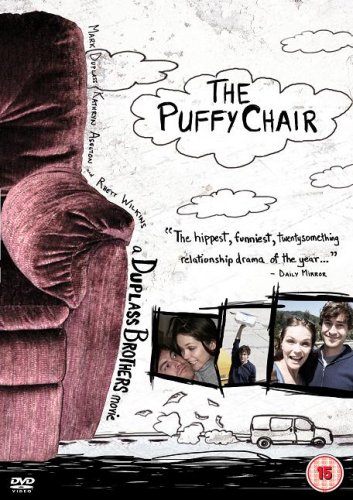
With Cyrus being hailed as one of the better comedies to come out in 2010, I thought I'd check out what else the directors, the Duplass brothers, created before their success with this latest film. According to the IMDB, Cyrus is only the directors' third film and it's the first one to have a large-ish budget. Before that, the directors had made two "mumblecore" films called The Puffy Chair and Baghead, both of which were made on an incredibly-low budget and utilized a variety of minimalist techniques to enhance the film. "Mumblecore", for those unaware, is a new style of film that tends to focus on realistic characters, usually twentysomethings in college, that are placed in realistic situations with natural-sounding dialogue. In short, realism is very important to the "mumblecore" genre and it is, admittedly, an interesting style of filmmaking. For instance, things like texting and teenage slang are typically common in these types of films and are considered a major component of the realism. Regardless, this would be my first time watching a "mumblecore" film and, while it was creative, I'm not sure if I'd call The Puffy Chair a "good film".

The film follows the laid-back Josh, his brother, Rhett, and his girlfriend, Emily, as they drive cross-country to pick up Josh's father's birthday gift - a giant purple LazyBoy chair. Though the gift seems random, it's actually very sentimental as Josh's father used to own an identical chair when the family was much younger. As the group travels from New York to Virginia, Josh must come to terms with his crumbling relationship while surviving the bizarre events that take place along the way.

In terms of characterization and dialogue, the film's pretty snappy. Because of the focus on realism, the film's characters feel all the more human, relateable, and likable. Josh, Emily, and Rhett make for some goofy, albeit lovable, characters and it's easy to care for them because of how real and genuine they feel. The dialogue, as I said before, is also very realistic thanks to the slang, long pauses, and use of "filler" phrases such as "Um" or "Well, I dunno...". The dialogue furthers the authentic feeling of the film and its characters, making it truly feel like a film that's heavily based in reality. There's a specific sequence in the film that really showcases the realism that I'm talking about. Taking place in Rhett's apartment, we see the trio enjoying some fresh pizza while discussing Rhett's interest in nature and film.  It's very minimalist and the scene is mostly comprised of "Yeah, man"s and repetitive dialogue. It feels very much like an actual conversation and, to me, is the best example of the film's realism.

 That said, though, The Puffy Chair certinaly seems to break its focus on realism for the sake of dramatic tension. For example, there's a sequence where Rhett confesses to wanting to marry a girl that he's only known for less than 24 hours. He isn't kidding either - he's completely serious. You'll hear stories like these on rare occasions, but it's far from something common in life. It's because of events like these that the film feels just as realisitc as it does unrealistic. It's as if the screenwriters realized that real life can't make a well-structured film and added some random events to kick some life into the film. The flip-flopping between randomness and realism makes the narrative feel indecisiive and confused.

The cinematography's decent for an independent film. While the camera is of a nice quality and the editing's fair, the lack of composition and structure really shows. The camera's all over the place and doesn't feel cinematic or contemplative at all. Frankly, it's only a step above home movies. There isn't too much to say - the visuals are decent but they could've been much, much better.

Overall, The Puffy Chair is only a decent film. While the characters are likable and the dialogue's realisitc, the rest of the film is pretty lacking.

Sunday, August 8, 2010

Entry#186: Mary and Max

Trailer

Oftentimes, people overlook the small gems that surface in film festivals like the Sundance Film Festival or the Cannes' Film Festival. They're content with watching mainstream and Hollywood-produced films, that frankly end up sucking, but, for some reason, can't seem to give smaller films such as Mary and Max a chance. Whether this is due to the common misconception that independent films are "overly artsy" or because the mainstream film industry is more accessible, films like Mary and Max go unheard of. Meanwhile, trashy flicks likes Transformers 2 and Twilight are making millions of dollars despite their very low quality. It's just a shame, as filmmakers like Adam Elliot (Harvie Krumpet, Mary and Max) have more talent than half of the mainstream industry. Regardless, though, Mary and Max proves to be a touching and darkly comedic film.

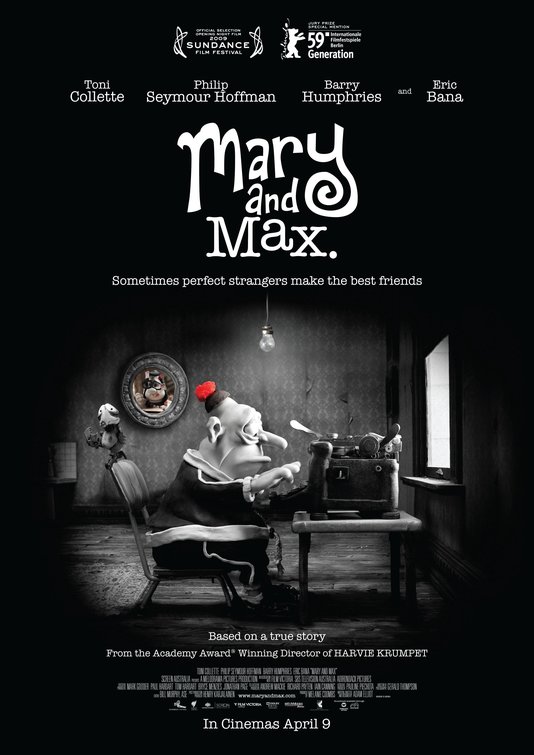
The film stars the titular Mary and Max, one of whom is a lonely eight-year-old girl in Australia and the other an atheistic Jew from New York with Asperger's, as they form a friendship as pen pals. After many more letters, and plenty of strange conversations, the two develop a very close friendship and prove to be the only friends they have in the world. The rest of the film follows the duo as their friendship soars and wanes over the next twenty-two years.

The film's great in terms of characterization. The characters are well-written, lovable, and genuinely interesting. Max, for instance, is just as hilarious as he is pitiful. I felt a deep sense of sadness for his situation but, at the same time, enjoyed his hilarious dialogue and sense of unintentional humor. He was just such a great character and Phillip Seymour Hoffman gave a fantastic performance to compliment Max's character. Mary was also a naive, yet charming, little girl and I really felt her presence in the film as well. She's just as well-written and depressed, yet hopeful, as Max is.These two characters interact with each other lovingly in a way that's very human, very real, and very heart-felt.


The claymation of the film is simply splendid. It gives the film a nice look and the lighting used in the film, from the artificial light of Australia to the darkly-lit streets of New York, provides just as much symbolism as it does atmosphere. Loneliness is a key theme to the film, and it can be felt through the film's visuals. The dilapidated and black look of New York, for example, shows the coldness and sadness inhabited by Max's world. It isn't actually until Mary sends him a gift, a rubber ball, that some color shows up in his world. It's well-animated, framed, edited, and is pure eye-candy.


Also, I'm not usually a big fan of narration, but the narrator in this film (Barry Humphries) was just superb. Not only did he deliver his lines with a strong sense of meaning and storytelling, but it furthered the feel of a nighttime story that the film has. It's somewhat tragic, somewhat poetic, and somewhat fairy tale-like. All in all, though, it's a film that has a big heart and a love for lonely people.


If I did have a problem with the film, though, it lies in the some of the more unbelievable aspects of the story. I don't believe, for example, that Mary would've continued writing Max after an eight-month hiatus. Not only that, but some of the plot events felt like unneeded reasons to create drama or tension in a narrative that really didn't need it. The film's about Mary and Max - that's it. I don't think the asylum sequences or the hiatus were really that necessary, as they really seemed to drag out during the film's narrative. Regardless, it's not a huge flaw.


It may not be perfect, but it doesn't need to be. Mary and Max is a sweet, smart, and very emotional film. Sometimes the plot seems to take precedence because it feels like "nothing's happening" - which isn't a bad thing - but the characters are truly the focus. With a witty sense of black humor and wonderful visuals, the film's a treat in all aspects.

Saturday, August 7, 2010

Entry#185: The Birth of a Nation

Trailer

The Birth of a Nation is both famous and infamous within film history.  From critics to Woodrow Wilson, the film has garnered plenty of attention due to its sheer invention and innovation of cinematic language and its uncompromising racist overtones. In fact, the film glorifies the KKK as "heroic knights" during the film's long third act.  It's uncomforting, to say the least, but not all films have to be "right" in order to be great.  The Triumph of the Will, for example, is a very well-made film that happens to promote Nazi ideals and makes a god out of Adolph Hitler. It's despicable, but to completely dismiss the film is disrespectful to the technical achievements and landmarks of the film. The same applies to The Birth of a Nation. D.W. Griffith, the director of the film, may have displayed a shocking amount of racism (even in an age where racism was common), but he made up for it by virtually creating the cinematic techniques that filmmakers still use to this day. Fading out, fading in, split-screen, flashbacks, and wide-angle shots are only a handful of Griffith's very important contributions. Regardless of its racism, the film's still a great landmark in film history.

The film follows two families, the Northern Stonemans and the Southern Camerons, before, during, and after the American Civil War. Before the South's secession and the ensuing violence, the two families were quite close and the sons, especially Benjamin Cameron, found themselves attracted to the daughters of the other family.  They often visited, wrote to, and shared long hours with each other during their carefree days. Once the war broke out, though, the families grew apart as their sons were sent out to kill one another. The rest of the film follows the eldest sons of the families as they go through the Civil War, the Reconstruction, and the birth of the Ku Klux Klan.

Before going any further, it's best to acknowledge the film's racism before anything else. From the start, the racism is quite blatant as all of the blacks are portrayed as simpletons, idiots, hooligans, thieves, dishonest workers, lazy men, and overall 'animal-like'. It's sad, really, that anyone could truly believe that their fellow man could actually behave like this. At the same time, however, it's a dark side of history that we need to face. The racism, though obvious, is only present in the background of the first half of the film. It wouldn't be too difficult to ignore the racism in the first half by completely focusing on the sentimental and human stories of the Stoneman and Cameron families. After the first half, however, the film takes a dramatic shift and brings its racist agenda to the forefront of the film. Portraying an equal rights Senator as misguided, and possibly "tricked" by his mulatto servant, the film states that blacks are trying to "take over" the South for their "Black Empire". It's ridiculous. Even if the film didn't have a racist agenda, the film's politically-charged second half seems nowhere near as powerful as the first half's emotional and heart-felt story. The characters are still focused on during the second half, but it seems more like propaganda than anything else. The sheer shock of the sights in the second half, such as an animal-like black man's attempted rape and Christ appearing before the world to "congratulate" the KKK, are both unsettling and depressing. Still, the film's still technically impressive during these moments and the editing and cinematography remains ground-breaking.

Moving on, though, the film's storytelling methods and characters are amazing and way ahead of their time. Griffith created a complex narrative in a cinematic world where the most complicated films beforehand were A Day in the Life of a Fireman and The Great Train Robbery. The characters and the setting feel like something out a richly-written and thoughtful novel, thanks to the well-developed characters and the fluid style of editing. This film marks the creation of the typical American epic that everyone's become so accustomed to. The editing and characters proved that films could go beyond simple and remedial shorts - that films could tell epic stories such as the ones found in popular or classic novels. The characters are interesting and very likable, allowing for complex characters that we can relate to and care about. Yet another innovative success on the film's part.

It's insane to think that a film crew in 1915 could create such visual accomplishments such as the renowned battle sequence during the film's second act. The fighting spanned for miles and the action felt just as dream-like as it did realistic. The flowing nature of the editing makes the film go by quickly despite the film's three-hour runtime. This editing allowed for the narrative to never seem stagnant or disjointed - it was meant to create a storyline that both enticed and thrilled audiences and to show the birth of a new "nation" of art. The cinematography's very impressive as well, as the camerawork was fantastic and the cinematic techniques felt fresh due to their recent creation within the film world.

It's sad, though, that the film promotes plenty of great messages while simultaneously promoting racism. The film speaks of the horrors of war, the nurturing of family, the importance of forgiveness, etc. and so forth. The Birth of a Nation paved the way for cinema as we know it, but its racist overtones are difficult to ignore. Other than those overtones and an iffy introduction, the film's a great landmark and is a "must-see" for anyone who's interested in film.

Friday, August 6, 2010

Entry#184: A Night in Casablanca


Though many consider A Night at the Opera to be one of the Marx Brothers' best films, I actually think it's one of their weaker films (out of the few that I've seen). It's still great, don't get me wrong, but MGM's strict ethical code forced the brothers to "clean up their act" in order to appease a larger audience. This meant that the relentlessness and anarchic nature of their humor was completely thrown out the window. Most of the sequences were still funny, yes, such as the state room scene in A Night at the Opera, but it lacked the sharpness and utter freedom that made the Marx Brothers so funny to begin with. They'd been tamed, leashed, and stripped of their ability to do whatever they wanted. They could only make fun of certain individuals, had to have motivations behind their jokes, and always had to help out their fellow man. It was too tame and this lasted for another four films until the brothers' contract with MGM ran out. After that, United Artists picked up the brothers' act and restored much of their previously-vanquished freedom. In this indirect parody of the blockbuster classic Casablanca, the Marx Brothers were able to bring a sense of chaos back to their wicked sense of humor.

Following the murders of two managers of a hotel, Groucho is hired to replace them. What Groucho doesn't realize, though, is that Count Pfefferman - a resident of the hotel and undercover Nazi - has been killing off the hotel managers to keep suspicion away from his secret life and his horde of gold hidden within the hotel's elevator shaft. Eventually joining up with Chico, a merchant, and Harpo, Pfefferman's former servant, the comedic team must maintain "order", if you will, at the hotel while aiding a young French soldier in his quest to clear his name.

Thanks to United Artists' looser rules, the Marx Brothers are able to return to their relentless style of humor. Groucho, for instance, is free to humilate the upper class, the poltical, and the undeserving once again as of this film. With the exception of the French soldier and his lover, nobody's safe from any of the brothers' ridicule and it's a wonderful return to style. The humor's as freash as ever in this film as well. There are plenty of memorable quotes and moments, mostly coming from the group's loud-mouth (and my personal favorite of the bunch) Groucho. Chico and Harpo are great as well, and there are plenty of humorous moments coming from their characters. The charades scene between those two, for instance, has to be one of the film's highlighted moments.

What separates the Marx Brothers' films from other comedies, though, are their focus on character. The brothers, along with the usually theatrical supporting cast, aren't exactly landmark-making, but they're very cartoon-like which gives them an instant sense of likalbiltiy. In other words, the Marx Brothers are almost like the live-action versions of Mickey, Donald, and Goofy from Disney - they're silly yet very lovable. Every minute spent with these hilarious and clever comedians is a minute of laughs, charm, and appreciation.

However, I wouldn't say that A Night in Casablanca is perfect. Firstly, the film takes *way* too long to start. I don't mind waiting for the brothers to make their entrance, but fifteen minutes of an expositional opening feels like too much and it drags itself out before we meet any of the Marx brothers. It's not a major flaw, mind you, but those fifteen minutes feel like an etenrity. Next, despite moving over to United Artists, brothers were still expected to put on a few musical numbers in order to please crowds. These musical numbers feel like pointless filler, though, as the only served to meet major auidences' expectations. They exist simply for crowd-pleasure and, by this point in time, the random vaudeville piano performances feel random. They'd work onstage, no question about that, but there's no excuse for them to be present in a film.

As far as cinematograhpy goes, there isn't much to say. The camerawork's nice and the editing is fairly decent and gets the job done. There are moments when the editing aids in the joke-telling, but these moments don't happen often.

A Night in Casablanca, though, proves to be a fresh comedy. It's got a few flaws, but it's otherwise charming, witty, hilarious, and just plain fun.